Avoid Double-Booking Site Resources
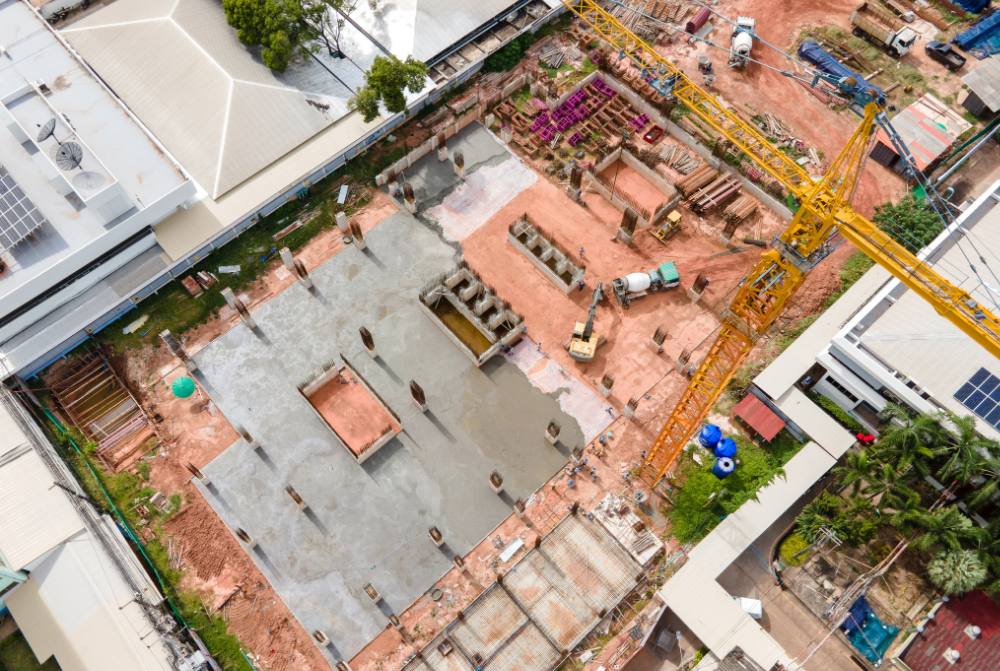
Every GC wants to avoid double-booking site resources, so they schedule everything. The site runs off a whiteboard, and for a while it works: everyone can see the week at a glance, and updates take thirty seconds. Then the schedule moves — a delivery slips, a pour gets pulled forward — and the whiteboard can't refresh fast enough to catch it. Two trades end up converging on the same 30 feet of laydown space, or a delivery and a concrete pour both need the crane at the same hour, because the plan changed faster than the process tracking it could keep up.
That gap is measurable, not just an inconvenience. Research on worker density and productivity gives an exact answer to how much a crowded site actually costs once resources stack up, and it's a bigger number than most people expect.
What does the research actually say about crowded sites?
Electrical Contractor magazine's coverage of trade stacking, citing research from the University of Wisconsin-Madison, puts precise figures on it: at a worker density of 191 square feet per worker, there's zero lost efficiency. Below that threshold, efficiency drops steadily, and at 90 square feet per worker, the research found a 50% loss of total efficiency.
That's not a rough estimate; it's a specific, measured relationship between physical crowding and lost productivity. And it applies to the same dynamic that plays out whenever a crane or a stretch of laydown space is double-booked: too many trades and too much material competing for the same limited physical space at the same time.
Why does double-booking resources happen even on well-scheduled projects?
Because a master or project schedule tracks task sequence and duration. It doesn't track whether the physical resources those tasks need are actually available at the same moment. Two tasks can each look perfectly scheduled in isolation while quietly requiring the same receiving area, the same crane, or the same laydown area at the same hour.
Procore's guidance on trade stacking describes the downstream effects plainly: when too many trades converge on the same space or resource, it creates congestion, inefficiencies, safety hazards, and quality issues. All consequences that show up on site, not on the schedule that failed to anticipate them.
What actually stops resource conflicts before they happen?
Visibility into what's already booked, at the resource level, not just the task level, and booked against the same time window as the work that depends on it, not tracked separately. That means:
- Every shared resource such as gate, crane, laydown zone, and forklift has its own bookable schedule, and can be booked for the same window as the delivery it's tied to, so a crane isn't just "available Tuesday" but confirmed for the same hour as the pour that needs it
- Tasks can be booked with the materials and area they depend on, not just a date, so a look at the schedule shows what's actually happening on site, where, and with what, not just what's due
- Bookings are visible to every trade that might need that resource, not siloed by trade or company
- Conflicts surface at the moment of booking, not when two crews physically arrive at the same spot
- Space allocation accounts for worker density, not just whether a task is technically scheduled for that day — a laydown area that's technically "free" on the schedule can still be too crowded to work in safely or efficiently if multiple deliveries land there at once
Common mistakes that lead to double-booking
- Scheduling tasks without scheduling the resources they depend on. A task's date on the schedule says nothing about whether the crane, lift, or space it needs is actually free.
- Booking a resource separately from the delivery or task it supports. A crane and a pour can both be booked and confirmed on their own schedules, but when either one shifts, nothing links them, so a change that moves the pour doesn't automatically flag that the crane booking now overlaps with something else. Without a shared view across resources, that kind of drift isn't visible until both are already on site.
- Siloed visibility by trade or company. If each subcontractor only sees their own bookings, nobody can see the conflict forming across trades.
- Worker density rarely gets factored into the schedule itself. A space can be technically available and still functionally overcrowded once multiple trades and deliveries converge on it.
- Resolving conflicts reactively, on site. By the time a conflict is discovered in person, it's already costing time. The fix has to happen at the booking stage, not the arrival stage.
FAQ
How do you stop double-booking a crane or receiving area?
By giving every shared resource its own visible booking schedule that all trades can see, and booking that resource against the same time window as the delivery or task it supports, so a conflict shows up when a second trade tries to book the same resource at the same time, rather than when both trades physically arrive.
What is resource contention on a construction site?
Resource contention happens when multiple trades or tasks require the same physical resource — a forklift, a crane, laydown space — at the same time, without a system in place to surface and resolve the conflict before it happens.
How much space does a construction worker actually need to stay productive?
Research cited by Electrical Contractor magazine found no lost efficiency at 191 square feet per worker, with efficiency dropping steadily below that threshold — reaching a 50% productivity loss at 90 square feet per worker.
How do you manage shared laydown space across multiple trades?
By treating laydown space as a bookable resource with visibility across all trades, rather than an open area that's allocated informally or claimed on a first-come basis.
See how Veyor gives every trade shared visibility into receiving area, crane, and laydown bookings before conflicts happen.





Get the latest insights into your inbox