Delivery Scheduling Software for Subcontractors: Run Your Own Delivery Plan Without Waiting on the GC


Delivery scheduling software for subcontractors gives a construction business one live delivery plan, from the factory, warehouse or yard to every active jobsite, without depending on the general contractor's system. If deliveries across your projects are still coordinated through spreadsheets, whiteboards and phone calls, that gap is exactly what this software closes.
Many subcontractors already know Veyor as the system builders use to manage incoming deliveries. Fewer know it works the other way too: a subcontractor can run the same platform independently, coordinating their own materials, drivers and deliveries across every live project, whether or not the GC uses Veyor at all.
This post covers the coordination problems that come with manual delivery management, then walks through what delivery scheduling software actually does for a subcontractor, from planning through proof of delivery.
How do subcontractors coordinate deliveries across multiple projects today?
For facade, precast, formwork, structural steel and other delivery-heavy specialty trades running several live projects at once, delivery coordination usually still runs on:
- A spreadsheet per project, updated by hand whenever something changes
- A whiteboard in the office that's only as current as the last person who updated it
- Phone calls and texts to drivers for collection times, routes and site instructions
- Photos and dockets spread across different phones and inboxes
- One person spending hours a day chasing down the latest status
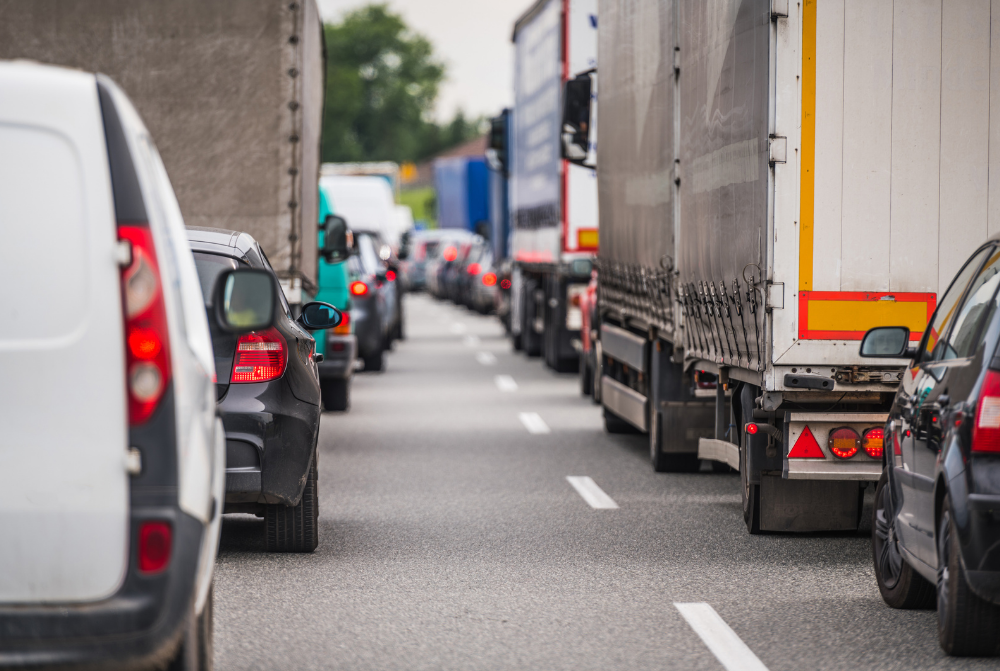
The pattern repeats itself project after project. Warehouse teams don't know what's already been dispatched. Drivers, especially third-party drivers, get different collection times, routes and site requirements depending on who they spoke to and when. Site teams can't confirm whether a delivery has left the yard, is in transit, or has already arrived, so every question becomes a phone call.
The cost shows up beyond wasted time. When materials are late, damaged, rejected or returned, there's often no reliable record of what actually happened: who signed for it, what condition it arrived in, or where the breakdown occurred. For an owner or operations director running multiple projects, that turns into disputes with suppliers, friction with the GC and no clean record to point to when something goes wrong.
Can subcontractors use delivery scheduling software without the general contractor?
Yes. A subcontractor's delivery operation, moving materials from a factory, warehouse or yard to every live jobsite, is a separate problem from whatever system a builder runs on any single project.
If your team already knows Veyor from booking deliveries into a builder-managed site, that's a different use of the same platform. Used independently, it becomes your own delivery coordination system: one shared plan across every project you're running, regardless of which GC is on which job or whether they use Veyor at all.
That distinction matters because it removes the usual objection. This isn't a request to get the builder to adopt new software, and it isn't a loading dock or building management tool being repurposed. It's a subcontractor's own delivery record, built around how your warehouse, drivers and site teams actually work.
What does delivery scheduling software for subcontractors actually do?
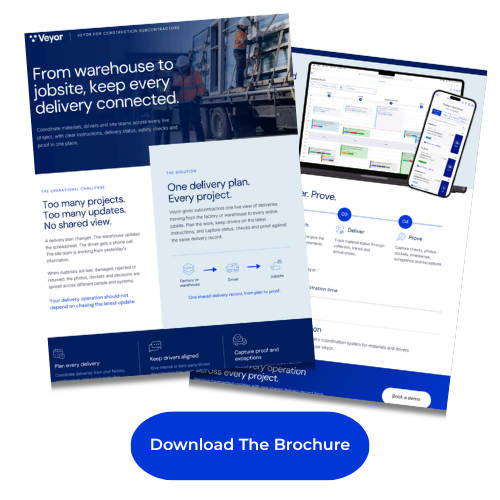
A subcontractor delivery scheduling system replaces the spreadsheet-and-phone-call approach with one connected workflow: plan, dispatch, deliver and prove.
Plan. Instead of a spreadsheet per project, warehouse, transport and project teams work from one live delivery plan across every job. Deliveries are organised by project, date, time and the resources required, and the plan updates in place when something changes, rather than living in five different versions across five inboxes.
Dispatch. Collection times, routes, gate details and unloading instructions travel with the load. Internal and third-party drivers get one clear job brief instead of a phone call, and pre-departure checks are captured before the vehicle leaves.
Deliver. Material status is tracked from collection through to arrival onsite, so warehouse and project teams know what's left, what's in transit and what's arrived without needing to ask.
Prove. Photos, dockets, timestamps and acceptance are captured against the same delivery record. If a load is late, damaged, rejected or returned, the record shows what happened and when, rather than leaving it to memory or a scattered group of phone photos.
Facade contractor ABS Facade saw this play out directly: moving bookings and approvals into Veyor cut logistics administration time by 80% and reclaimed 2 to 3 hours a day that had previously gone into manually planning and chasing deliveries. Results will vary by business and operating environment, but it's a clear example of what removing manual coordination looks like in practice.
How do subcontractors manage proof of delivery and safety checks?
Proof of delivery and safety checks tend to live in the same gap: scattered across phones, paper dockets and whoever happened to be on site. Delivery scheduling software puts both against the same record.
Driver, vehicle and load details, along with load restraint and pre-departure checks, get recorded before a delivery leaves the warehouse or yard. That record travels with the delivery and gets closed out with photos, dockets, timestamps and acceptance once it arrives. For businesses managing chain of responsibility obligations, particularly in Australia and New Zealand, that gives a consistent, retrievable trail rather than a patchwork of individual checks that may or may not have been documented.
When there's a dispute, an audit, or a customer question about a delivery, the answer is in one record instead of a search across texts, emails and memory.
Common mistakes when coordinating subcontractor deliveries
- Treating delivery coordination as the GC's problem to solve. A subcontractor's delivery operation runs across every project, not just the ones where a builder happens to require formal booking.
- Leaving drivers to work out instructions by phone. Every call is a chance for a collection time, route or site requirement to get lost or misremembered.
- Only noticing a gap in the record after a dispute. Proof of delivery and safety checks need to be built into the process, not reconstructed after something has already gone wrong.
FAQ
What is delivery scheduling software for subcontractors?
It's a system that lets a subcontractor plan, dispatch, track and prove deliveries of materials from a factory, warehouse or yard to every live jobsite, connecting warehouse teams, drivers and site teams through one shared record.
Do subcontractors need the general contractor to use the same system?
No. A subcontractor can run delivery scheduling software independently of any GC's system, coordinating their own materials, drivers and deliveries across every project they're working on.
How does delivery scheduling software help with proof of delivery?
It captures photos, dockets, timestamps and acceptance against each delivery record as it happens, so there's a retrievable answer when materials arrive late, damaged, rejected or returned, instead of a scattered search across phones and paperwork.
What's the difference between subcontractor delivery software and GC-managed logistics platforms?
GC-managed platforms coordinate deliveries into a single builder's site. Subcontractor delivery scheduling software coordinates a subcontractor's own materials and drivers across every project they run, regardless of which GC is on each job.
How much time can subcontractors save on logistics administration?
Results vary, but ABS Facade reduced logistics administration time by 80% and reclaimed 2 to 3 hours a day after moving bookings and approvals into Veyor.
See Veyor for Subcontractors
See how Veyor connects your warehouse team, drivers and jobsites through one shared delivery record.

Get the latest insights into your inbox