Procurement Delays in Construction are a Schedule Risk. Here's How GC Leaders Catch Them Early.

Procurement delays in construction rarely arrive as a surprise. They build quietly for months. The switchgear submittal starts late. An approval slips. A supplier moves a date. Then, weeks before energization, the project team learns the gear will land two months late.
Nobody made a single big mistake. The risk just wasn't visible to the people who could act on it.
Key takeaways
- Longer lead times have put procurement on the critical path of many projects.
- Most procurement delays start in submittals and approvals, long before an order is placed.
- Leaders see the risk late because procurement status is rebuilt by hand for every meeting.
Why are procurement delays in construction now a schedule risk?
Lead times on critical equipment have grown longer than many schedules allow for. When an item takes over a year to make, a few weeks lost in review can push installation, commissioning and handover.
Medium-voltage switchgear now runs 52 to 80 weeks, up from around 24 weeks before the pandemic, according to Industrial Sage. Transformers, generators, façade systems and elevators follow the same pattern. On an MEP-heavy project, a handful of late items can decide the handover date.
What causes procurement delays in construction?
Most delays start before an order is placed. The usual causes are late submittal starts, slow approvals, changing lead times and a procurement log that isn't connected to the current schedule.
- Late starts. The submittal should have started weeks ago, but nothing flagged it in time.
- Slow approvals. Review cycles and resubmittals use up the time buffer before anyone notices.
- Moving lead times. A supplier pushes back a delivery date, and the log is never updated.
- Disconnected schedules. The project schedule changes, but the procurement log still shows old dates.
Why don't project leaders see procurement risk sooner?
Procurement status lives in spreadsheets maintained by the project team, then summarized by hand before each meeting. By the time a risk reaches leadership, it's already an issue.
That's a structure problem, not a people problem. In Veyor's beta with five enterprise general contractors, one team said manual tracking consumed about a quarter of its capacity, rising to half at project start. That's the same team you need resolving risk, not reporting on it.
What should a project director see at any time?
A project director should be able to answer three questions in under a minute. Which items are at risk? What date matters next for each one? Who is holding it right now? If those answers take a day to prepare, procurement risk is being managed too late.
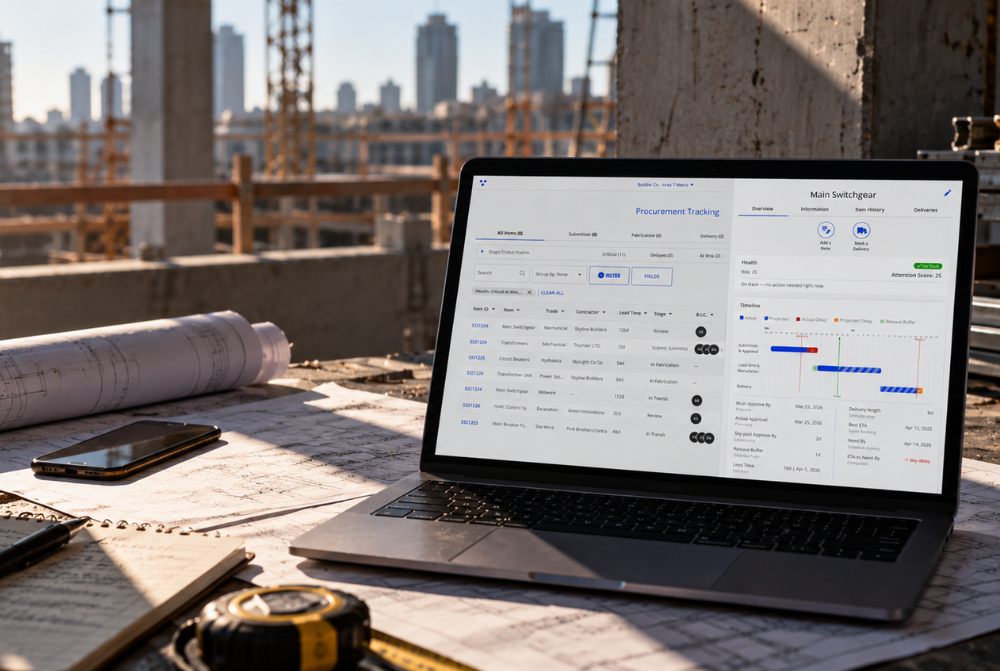
That's the idea behind Veyor Procurement Tracking: know what's at risk and what happens next.
How Veyor helps GC leaders act earlier
Veyor gives project teams and leaders one live view of procurement risk. Submittals come in from Procore. The P6 schedule is imported to set real Need-By dates. Veyor calculates when each item must start and be approved, then flags what's at risk. The team acts early. Leadership sees the same picture without a manual report.
It works at enterprise scale. One beta customer tracks between 2,000 and 3,000 items across eight trades on a single project.
- Fewer late surprises on the items that decide your handover date.
- Team capacity back for project work, not log maintenance.
- Clear answers in owner meetings, backed by a live record.
Procurement delays in construction FAQ
How do procurement delays affect the critical path?
When a critical item arrives late, every activity that depends on it moves too. On MEP-heavy projects, late electrical gear can delay energization, commissioning and handover.
How can general contractors reduce procurement risk?
Track every item from the first submittal, work backward from the Need-By date, keep procurement connected to the live schedule and review at-risk items weekly.
What are long lead items in construction?
Materials or equipment that take months or years to make and deliver, such as switchgear, transformers, generators, elevators and custom façades.
Talk to Veyor about Procurement Risk Reduction
Procurement risk is schedule risk. Veyor helps your teams catch it early and act before it reaches the critical path.



Get the latest insights into your inbox