Real-Time Construction Schedule Updates: When a Delivery Slips, the Whole Site Knows
"Real-time" is one of the most overused phrases in construction software marketing, which makes it easy to miss that there's real, quantified cost behind the specific problem it's supposed to solve: schedule data that's accurate but late.
Being late is its own category of bad data, separate from being wrong. A delivery status that's correct but three hours old can be just as costly as one that's simply incorrect, because decisions get made against it before the update catches up.
What does "untimely" data actually cost?
FMI Corporation's research on data strategy in construction, conducted with Autodesk, defines "bad data" as data that is "inaccurate, incomplete, inaccessible, inconsistent, or untimely." Applying an IBM estimate of what bad data costs the US economy to global construction output, the authors estimate that bad data may have cost the global construction industry $1.84 trillion in 2020. The report also draws on a survey of 3,916 industry professionals across North America, Europe, and Asia-Pacific.
Untimely data is a different problem from inaccurate data, even though the FMI report groups them together. In the 2018 Construction Disconnected survey by PlanGrid and FMI, 21% of respondents blamed "lack of responsiveness of data/information delivery" when tasks ran over time, a separate answer from the 19% who cited confidence in the data's accuracy. Dodge Data & Analytics' 2019 research also rated timeliness and accuracy as separate qualities of field data, and one contractor in that report pointed out that work-in-progress reports are often "anywhere from a week to a month old," by which point "you've already spent the money." A delivery tracking system that correctly records a delay but only tells the office three hours later is in the same position: the data is accurate, but it arrives too late for the decisions that had to be made in those three hours.
What happens without live delivery updates specifically?
The same Construction Disconnected survey shows how much of the industry's rework traces back to information problems. US respondents attributed 48% of rework, an estimated $31.3 billion of the $65 billion total, to poor project data and miscommunication. And as noted above, a fifth of respondents said the issue behind lost time wasn't wrong information. It was information that arrived too slowly to use.
Applied specifically to deliveries, this plays out as a predictable cascade: a delivery slips, but the schedule doesn't reflect it immediately. The crew scheduled to receive that delivery isn't notified in time. They either wait unproductively or start improvising around a gap nobody planned for. By the time the schedule "catches up" to reality, the cost has already been incurred.
What does a genuinely live delivery schedule change?
The difference isn't cosmetic. It changes when a problem becomes visible relative to when it becomes costly. That timing matters more as decision windows shrink: in the FMI/Autodesk survey, 75% of respondents agreed that the need for quick, real-time decision-making is increasing at the project level.
- A delayed delivery is flagged the moment it's known to be late, not discovered when a crew is already on site waiting for it
- Dependent tasks and bookings update automatically, rather than requiring someone to manually notice a slip and update every downstream commitment
- The lookahead and Last Planner make-ready check reflect current status, not a snapshot from the last planning meeting
- Everyone working from the schedule sees the same, current picture, not a version that's only accurate for whoever last refreshed it
How does Veyor handle a delivery that slips?
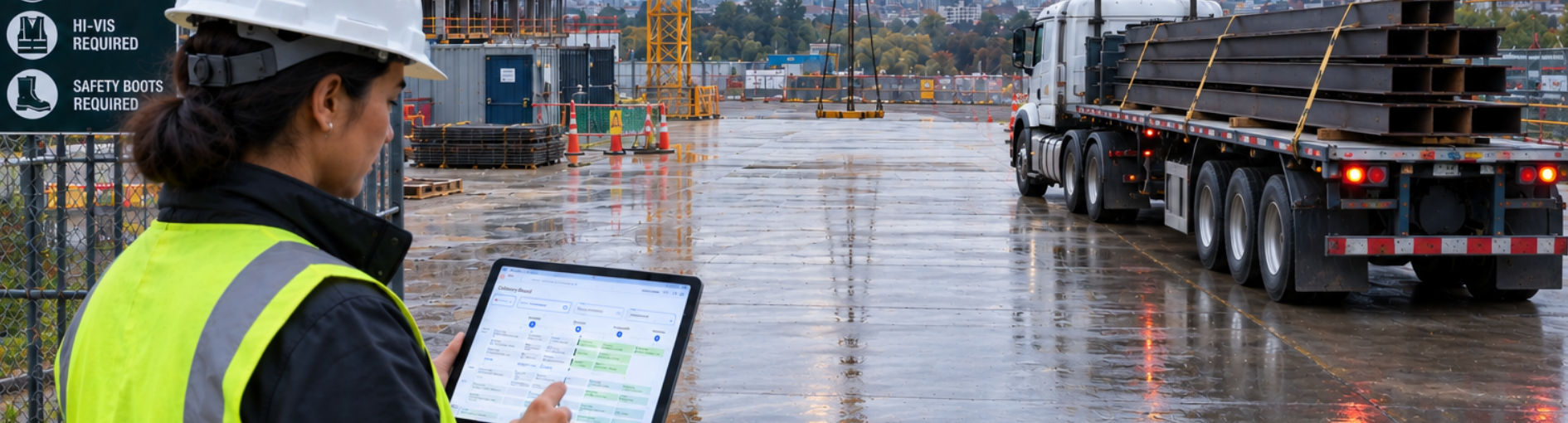
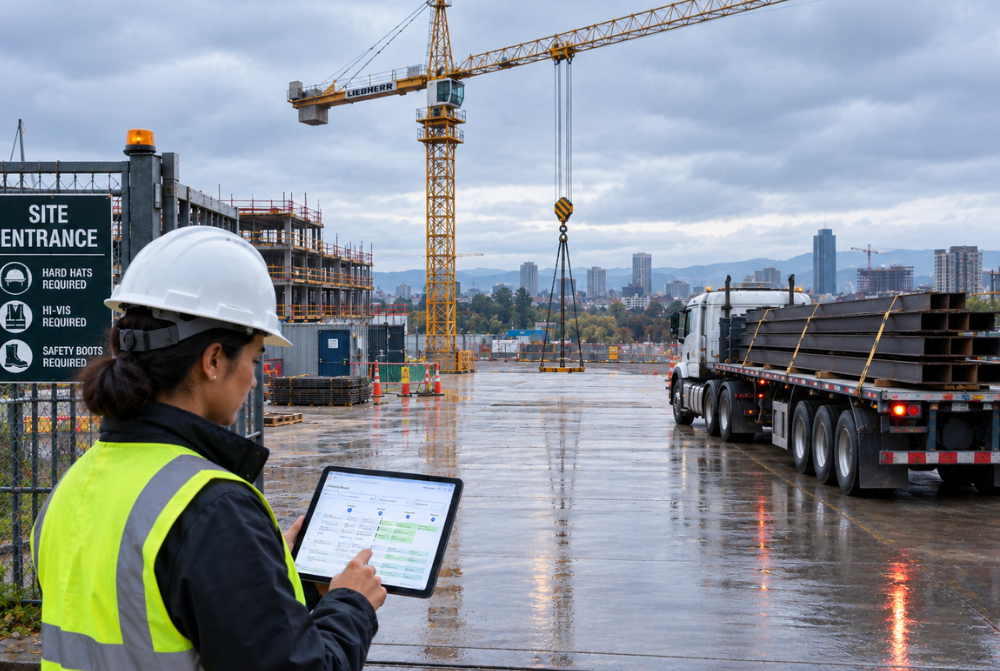
Picture a steel delivery booked for 7am, with a crane lift scheduled straight after. At 6:20, GPS tracking shows the truck stuck in traffic across town. The site team doesn't find out at 7:15 from an empty gate, they find out while there's still time to act. Because the crane booking is linked to the delivery, they can see which lift depends on it, and Bulk Shift moves both bookings back in one step. The public display board shows the new times straight away, so the crane crew, the gate, and everyone else on site are working from the same schedule without logging in or making a phone call.
Common mistakes with "real-time" scheduling claims
- Confusing "digital" with "live." A schedule that's stored digitally but only updated manually, occasionally, isn't real-time. It's a digital version of a static document.
- Treating timeliness and accuracy as the same problem. Contractors report slow information and inaccurate information as separate causes of lost time, so fixing data accuracy alone won't close the timeliness gap.
- No automatic cascade when a delivery updates. If a delay has to be manually propagated to every dependent task, the "live" update is only as fast as whoever remembers to do that.
- Relying on end-of-day or weekly reconciliation. By the time a weekly report catches a delivery slip, the cost of the resulting idle time has already happened.
- Tracking the booking, not the truck. A booking only changes status when someone updates it. Without GPS tracking, the first sign of a late delivery is often an empty slot at the gate.

FAQ
How do real-time schedule updates actually work?
A live scheduling system reflects status changes, such as a delayed delivery, across the schedule as soon as they're recorded. It updates dependent tasks and notifies affected teams automatically, rather than relying on manual updates that lag behind what's happening on site.
What happens to dependent tasks when a delivery slips?
In a live system, tasks and bookings that depend on that delivery update automatically to reflect the new timing. Without live updates, dependent tasks continue to appear on schedule until someone manually catches and corrects the discrepancy.
Why is my construction schedule always slightly out of date?
Most schedules are updated manually and periodically, at a daily standup or weekly meeting, rather than continuously. That gap between an event happening and the schedule reflecting it is one of the five types of bad data defined in FMI and Autodesk's research: data that's untimely, even when it's accurate.
Is "real-time" scheduling software actually different from digital scheduling software?
Yes. A digital schedule can still be updated manually and infrequently. Real-time scheduling specifically means status changes propagate automatically and immediately, without requiring someone to notice and manually update the record.
Can construction delivery software track trucks in real time?
Some can. Veyor uses GPS tracking to follow deliveries from the road to the gate to unloading, so site teams can see a delay coming instead of waiting for a truck that hasn't arrived.
See how Veyor keeps every delivery, crane, and hoist booking current, so crews know about a slip before it costs them time.
Plans on site change faster than anyone can update them by hand. Veyor can help you keep your team in "real-time".




Get the latest insights into your inbox